Dead Men's Hands: The Surprisingly Violent History Behind America's Most Common Greeting
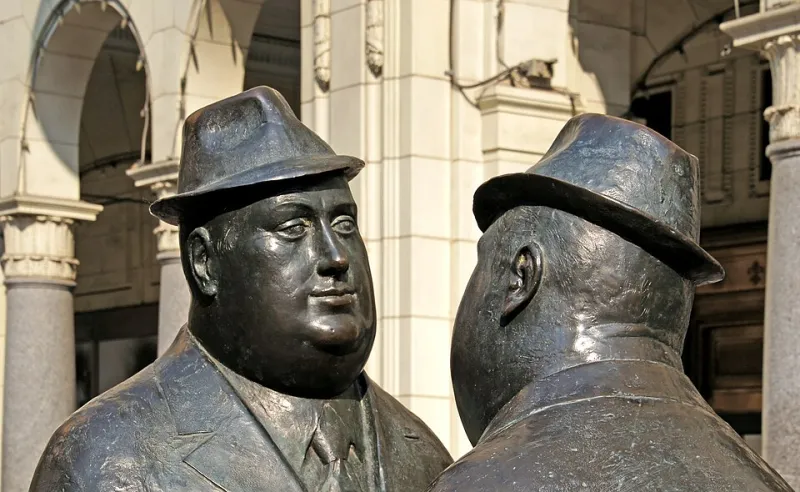
Photo: Bernard Spragg. NZ from Christchurch, New Zealand, CC0, via Wikimedia Commons
You've done it thousands of times. A stranger walks toward you, extends a hand, and without thinking, you grab it, pump it twice, and release. It feels natural. Automatic. Deeply American, even. But the reason you're doing it at all has nothing to do with warmth or welcome. It has everything to do with the fact that, for most of human history, a man's right hand was where he kept his sword.
The Original Weapon Check
The handshake's most commonly cited origin story places it in medieval Europe, and while historians debate the exact timeline, the logic is hard to argue with. When two armed men approached each other — whether on a road, at a gate, or before a negotiation — extending the right hand was a way of signaling that it was empty. Grabbing it and holding it was a way of making sure it stayed that way long enough to have a conversation.
The up-and-down pumping motion that Americans are famous for may have served an additional purpose: shaking the sleeve to dislodge any hidden blade. Whether that's literally true or just satisfying folklore, it captures something real about what the gesture was communicating. I'm not going to kill you. At least not right now.
From there, the handshake spread across European cultures as a general symbol of agreement and trust — a physical seal on a deal. Quakers in 17th-century England helped elevate it as a democratic alternative to bowing, which they considered an act of unequal submission. If you bowed to no one, you shook everyone's hand instead. That egalitarian framing would matter enormously when the gesture crossed the Atlantic.
Victorian Etiquette Turns a Gesture Into a Science
By the 19th century, the handshake had become a social institution — and the Victorians, being the Victorians, promptly turned it into an anxiety spiral. Etiquette manuals from the 1800s devoted serious real estate to the correct handshake. How firm? How long? Who extends first? Should a lady initiate with a gentleman, or wait? What does a limp grip say about your character?
These weren't idle questions. In an era of rapid social mobility, when industrialization was scrambling class hierarchies and strangers were constantly doing business with other strangers, first impressions carried enormous weight. The handshake became a quick-read character assessment. A man who gripped too loosely was suspected of weakness or dishonesty. One who squeezed too hard was considered aggressive or low-class. The ideal handshake — firm, brief, confident — telegraphed trustworthiness before a single word was spoken.
American etiquette writers latched onto this framework enthusiastically. The young republic had always been suspicious of the elaborate bowing and hat-doffing rituals of European aristocracy. The handshake fit neatly into American mythology: direct, unpretentious, equal. You didn't need a title or a lineage to give a good handshake. You just needed character.
How Business Culture Standardized the Grip
The real standardization of the American handshake happened in the late 19th and early 20th centuries, as the country built its modern business infrastructure. Salesmen, lawyers, politicians, and executives were shaking hands dozens of times a day, and the ritual calcified into a professional expectation with remarkably specific unspoken rules.
The firm handshake became a hiring signal. Etiquette coaches and business schools taught it as a skill. Dale Carnegie's How to Win Friends and Influence People, published in 1936, didn't invent the concept but crystallized what Americans already believed: physical presence and confident physical greeting were prerequisites for professional success.
What's fascinating is how regional this supposedly universal gesture remained. Researchers studying American handshake norms have noted persistent differences across geography. In parts of the South, a longer, warmer clasp with sustained eye contact is considered respectful. In the Northeast — particularly in financial and legal circles — a firmer, shorter grip signals efficiency and mutual respect without sentimentality. In the Midwest, the handshake tends toward the enthusiastic and prolonged, reflecting a cultural premium on genuine warmth. Visitors from one region meeting professionals from another have been quietly misjudged on grip strength for generations.
The Dominance Game Nobody Talks About
Psychologists have spent decades studying what the handshake actually communicates — and the findings are more loaded than most people want to admit. Research has consistently shown that people form lasting first impressions from a handshake within the first few seconds of meeting someone, with those impressions proving remarkably resistant to revision.
The angle of the hand matters. Offering your hand with your palm facing slightly downward is widely interpreted as a dominance signal — a subtle attempt to place your hand on top of the other person's. Politicians are notorious for this. Sales trainers teach it. And the person on the receiving end almost always registers it, even if they can't articulate why the interaction felt slightly off.
Then there's the two-handed clasp — where one person covers the joined hands with their free hand — which political scientists have half-jokingly dubbed the "politician's handshake." It reads as warmth and sincerity to some, as calculated manipulation to others. The fact that a wordless gesture can generate that kind of interpretive complexity says something remarkable about how much Americans have loaded into this thing.
A Gesture That Survived a Pandemic
For a brief moment in 2020, it looked like COVID-19 might finally kill the handshake. Public health officials suggested replacing it with elbow bumps, fist bumps, or simple nods. Some business etiquette coaches declared the handshake dead. It wasn't.
By 2022, handshakes had largely returned to American professional life, albeit with slightly more hesitation than before. The grip that started as a medieval weapon check, got refined by Victorian anxiety, and was standardized by American capitalism proved too deeply embedded to dislodge with a respiratory virus.
Which, when you think about it, is exactly what you'd expect from a gesture that's been signaling I come in peace for about a thousand years. Some habits are just too useful to let go of.