Before Computers, Scientists Used These 3x5 Rectangles to Revolutionize Human Knowledge
The Accidental Standard That Changed Everything
In 1877, Harvard University librarian Justin Winsor was drowning in chaos. Books were scattered across multiple catalogs, researchers couldn't find materials, and the library's filing system was a nightmare of incompatible formats. His solution seemed almost laughably simple: standardize everything on uniform 3x5 inch cards.
What Winsor didn't realize was that he'd just created the infrastructure for a knowledge revolution.
The index card wasn't invented at Harvard—variations had existed for decades. But Winsor's decision to mandate a specific size created something unprecedented: a universal format that could work across institutions, disciplines, and continents. Within twenty years, libraries from Boston to Berlin had adopted the same standard.
Darwin's Secret Weapon
Charles Darwin was already using handmade cards to organize his research when the standardized format emerged, but he quickly embraced the new system. His study became a laboratory of cardboard rectangles, each one containing a single observation, quote, or idea about evolution.
Darwin's method was revolutionary: one thought per card, with cross-references written in the margins. He could shuffle ideas physically, testing different arrangements of evidence until patterns emerged. When he sat down to write "On the Origin of Species," he wasn't staring at blank pages—he was assembling a carefully curated deck of insights.
This wasn't just Darwin's quirk. The index card system allowed him to think in ways that bound notebooks never could. Ideas became modular, moveable, and endlessly recombineable.
The Novelist Who Saw Literature in 3x5
Vladimir Nabokov took the index card obsession even further. The author of "Lolita" wrote his entire novels on index cards, claiming that the format freed him from the tyranny of linear narrative. He could write scenes out of order, experiment with different chapter arrangements, and revise individual moments without rewriting entire manuscripts.
Nabokov's cards weren't just organizational tools—they were creative instruments. He'd spread hundreds of cards across his study floor, creating a physical map of his story that he could literally walk through and rearrange. When publishers asked for manuscripts, Nabokov would hand them carefully ordered stacks of index cards.
The method worked. Nabokov produced some of the 20th century's most complex, layered novels using a system that looked deceptively simple.
Building America's Memory Palace
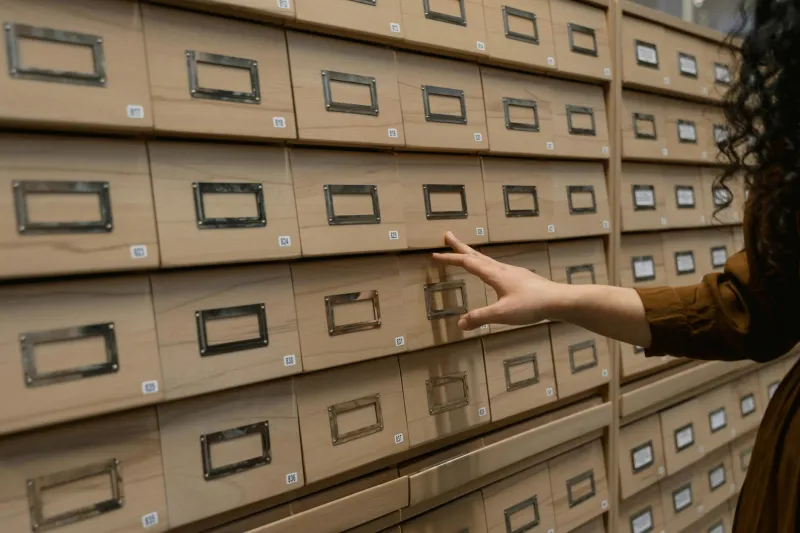
While writers and scientists were revolutionizing their work, librarians were using index cards to build something even more ambitious: a comprehensive map of human knowledge. The Dewey Decimal System, introduced in 1876, relied entirely on standardized card catalogs to function.
Melvil Dewey's classification system was brilliant in theory, but it needed the index card to become practical reality. Every book in every library got its own card, filed according to Dewey's numerical system. Researchers could walk into any library in America and navigate the same way, following the same card-based logic.
By 1900, the index card had become America's primary interface with organized knowledge. Want to find a book? Check the card catalog. Planning a research project? Start with the cards. The physical act of flipping through card drawers became as fundamental to intellectual life as reading itself.
The Science of the Perfect Rectangle
The 3x5 inch format wasn't arbitrary—it was the result of careful optimization. Cards needed to be large enough to hold meaningful information but small enough to shuffle easily. They had to fit in standard drawers and filing systems while remaining sturdy enough for constant handling.
Librarians tested different materials and discovered that a specific weight of cardstock provided the perfect balance of durability and flexibility. The slight texture of quality card stock made handwriting easier while preventing ink from bleeding through.
Even the corners mattered. Rounded corners prevented cards from catching on drawer edges, while the specific proportions of 3x5 made the cards easy to grip and manipulate with one hand.
The Digital Rebellion That Never Quite Happened
Computers were supposed to kill the index card. Why shuffle physical cards when you could search digital databases instantly? By the 1990s, most libraries had replaced their card catalogs with computer terminals, and researchers were expected to embrace digital note-taking.
But something unexpected happened. Many researchers discovered that digital tools, for all their power, couldn't replicate the tactile thinking that index cards enabled. You can't spread a database across your desk and see all the connections at once. You can't shuffle digital notes with your hands or accidentally discover new patterns while reorganizing a physical stack.
The Analog Renaissance
Today, index cards are experiencing a quiet renaissance. Tech entrepreneurs use them for project planning. Writers return to them for creative brainstorming. Students discover that handwriting notes on cards improves retention compared to typing.
The reason is neurological: physical manipulation of information engages different parts of the brain than digital interaction. When you move an index card from one pile to another, you're not just organizing data—you're thinking with your hands.
Modern productivity systems like "Getting Things Done" explicitly recommend index cards for capturing and organizing thoughts. Digital tools can store infinite information, but index cards force you to distill ideas to their essence.
The Enduring Power of Constraints
The index card succeeded because of its limitations, not despite them. The small format forced clarity—you couldn't ramble across multiple pages. The physical nature made organization tactile and visual. The standardized size created universal compatibility.
In an age of unlimited digital storage, the index card reminds us that sometimes the most powerful tools are the most constrained ones. Darwin organized the theory of evolution on cards that could fit in his palm. Nabokov crafted literary masterpieces on rectangles of cardboard.
The next time you see a stack of index cards, you're looking at one of humanity's most successful information technologies—a simple innovation that quietly revolutionized how we think, research, and create.