1873 Called. It Wants Its Keyboard Back.
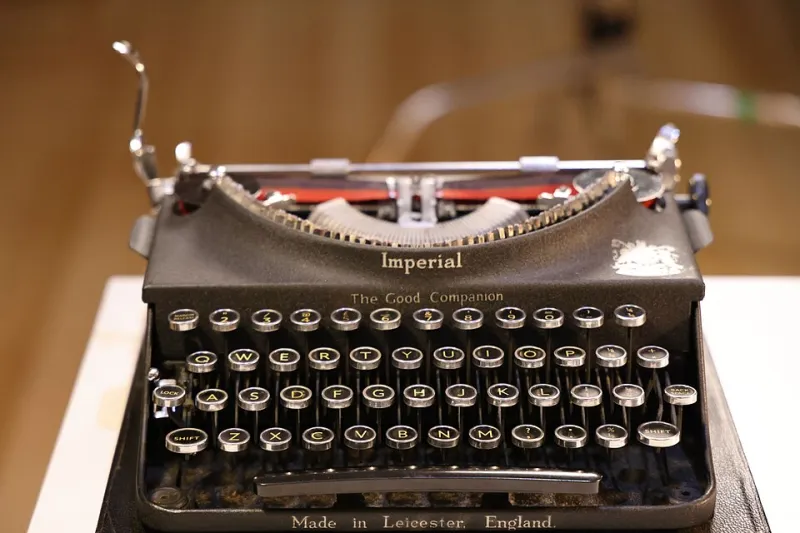
Photo: Bhullargraphic, CC BY-SA 4.0, via Wikimedia Commons
Look down at your phone for a second. That keyboard you're tapping right now — the one designed for glass screens and thumbs — uses the exact same letter arrangement as a machine built when Ulysses S. Grant was president.
QWERTY isn't a design choice. It's a fossil. And somehow, it's the most successful fossil in the history of technology.
A Machine That Kept Tying Itself in Knots
In the early 1870s, a Milwaukee inventor named Christopher Latham Sholes was tinkering with a writing machine in a machine shop. His prototype worked — mostly. The problem was that when typists got up to speed, adjacent typebars would swing toward the paper and collide, jamming the mechanism in a tangled metal heap.
Sholes' fix wasn't to make the machine better. It was to make the typing slower. By separating commonly paired letters across the keyboard, he reduced the odds of a jam. The layout that emerged — with Q, W, E, R, T, and Y lined up in the top row — was a mechanical workaround, not an ergonomic breakthrough.
In 1873, the gun manufacturer E. Remington and Sons licensed the design, and the QWERTY typewriter went into mass production. The jam problem was eventually solved by better engineering, but by then the layout had already shipped to offices across the country.
The Typing Contests That Sealed the Deal
Here's where the story gets genuinely strange. QWERTY didn't win on merit — it won on spectacle.
In 1888, a Salt Lake City court stenographer named Frank McGurrin entered a nationally publicized typing contest in Cincinnati. McGurrin was the only typist in America who had memorized the keyboard and typed without looking at his hands — touch typing — and he did it on a QWERTY Remington. He crushed the field, won a silver trophy, and made front-page news.
The lesson the public took away wasn't "QWERTY is optimal." It was "QWERTY typists are fast." Typing schools across the US retrained their students overnight. A generation of teachers, secretaries, and clerks learned one layout and one layout only.
That's the moment QWERTY stopped being a design and became an institution.
The Challengers That Couldn't Break Through
The alternatives kept coming. In 1936, an inventor named August Dvorak patented a layout he claimed was dramatically more efficient — vowels on one side, common letters under the strongest fingers. Studies (some funded by Dvorak himself) suggested real gains.
It didn't matter. By the 1930s, millions of American workers knew QWERTY. Retraining an entire office workforce to save a few words per minute made no economic sense. The switching cost wasn't the keyboard — it was the people.
Then came the computers, and with them, the perfect moment to start fresh. Software keyboards could be anything. Instead, every early terminal and PC adopted QWERTY wholesale, because the people buying them already knew how to type. The fossil fossilized again.
Your Thumb Is Typing on a Typewriter
The most absurd chapter is the smartphone. When touchscreen keyboards emerged in the 2000s, designers had total freedom — no physical keys, no mechanical constraints. Engineers built swipe gestures, predictive text, and autocorrect specifically to compensate for a layout never meant for thumbs.
Nobody seriously proposed changing it. Because every American who picked up the phone already knew QWERTY.
Economists have a name for this: path dependence. Once a standard gets locked in, the cost of switching outweighs the benefit — even when the benefit is real. QWERTY survives not because it's good, but because it arrived first and brought an entire workforce with it.
So the next time you fire off a text, take a small moment of appreciation. You're using a jam-prevention scheme from a Milwaukee machine shop, carried forward by a typing contest, a Remington factory, and 150 years of pure momentum.
The typewriter is long gone. Its keyboard just refuses to leave.