How One Man's Cheap Vacation Complaint Cloned Every Hotel Room in America

The Vacation That Changed Everything
In 1951, Kemmons Wilson was just a Memphis businessman trying to take his wife and five kids on a family vacation to Washington, D.C. What should have been a pleasant road trip turned into a masterclass in everything wrong with American hospitality. The motels were expensive, inconsistent, and often refused to accommodate families with children. Some charged extra fees per child. Others had no air conditioning, unreliable plumbing, or rooms that bore no resemblance to their advertised descriptions.
Wilson spent the entire drive home fuming about the experience. But instead of just complaining, he started sketching. By the time he reached Memphis, he had drawn up plans for a completely different kind of roadside accommodation — one that would eliminate every frustration he'd encountered on his disastrous family vacation.
The Birth of Radical Standardization
Wilson's solution was revolutionary in its simplicity: make every room identical. Not just similar — absolutely identical. Same layout, same furniture placement, same amenities, same color scheme, same everything. If a family stayed at his motel in Memphis, they would find exactly the same room waiting for them in Nashville, Atlanta, or anywhere else his chain expanded.
This wasn't how the hospitality industry worked in 1952. Hotels and motels prided themselves on unique character and local flavor. Each establishment was an individual business with its own personality, quirks, and standards. Wilson thought this was exactly the problem.
He opened the first Holiday Inn in Memphis in 1952, and every detail was designed around eliminating uncertainty. The rooms featured a standard layout: bed against the far wall, television positioned so it could be viewed from the bed, identical nightstands on each side, same bathroom configuration, same closet placement. Even the bedspreads and curtains were identical.
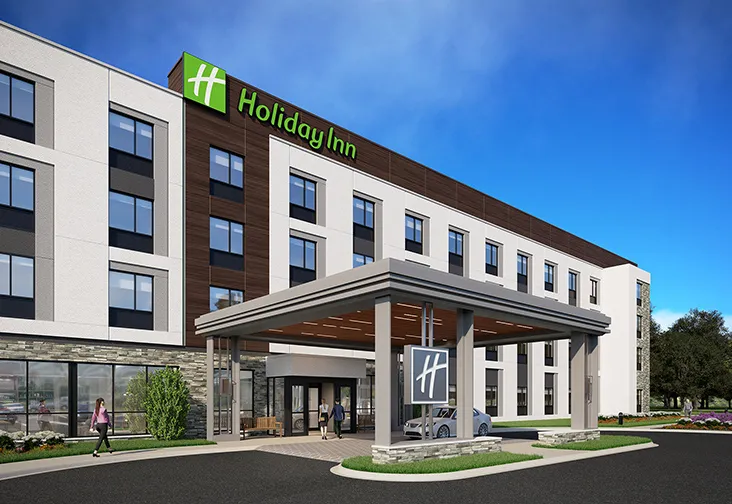 Photo: Holiday Inn, via design.holidayinn.com
The Psychology of Predictable Comfort
Wilson had accidentally tapped into something deeper than hospitality — he'd discovered the psychological comfort of predictability. Travelers, especially families, didn't want adventure in their accommodations. They wanted to know exactly what they were getting before they paid for it.
The standardized room layout solved multiple problems simultaneously. Families could plan their stays more effectively because they knew exactly how much space they'd have. Business travelers could work efficiently because they knew where to find electrical outlets, desk space, and lighting. Housekeeping could clean rooms faster because the layout never varied.
But the real genius was economic. By standardizing everything, Wilson could buy furniture, fixtures, and supplies in massive quantities, driving down costs. He could train housekeeping staff once and transfer that training to any location. Construction became cheaper because architects could reuse the same blueprints endlessly.
The Accidental Industry Revolution
Other hotel chains watched Holiday Inn's explosive growth and realized Wilson had cracked a code they hadn't even known existed. Ramada Inn, Howard Johnson's, and dozens of other chains began copying the standardized room concept. But they didn't just copy the idea — they copied Wilson's specific layout.
The bed-against-the-wall, TV-facing-the-bed, identical-nightstands configuration became the unofficial template for American hospitality. It wasn't because this layout was objectively superior to all alternatives — it was because Holiday Inn had proven it worked, and copying a successful formula was safer than experimenting with untested designs.
By the 1960s, the standardized hotel room had become so dominant that travelers began to expect it. A hotel room that deviated from the familiar layout felt wrong, uncomfortable, or poorly designed. Wilson's personal preferences had accidentally become America's hospitality standards.
The Unintended Consequences
Wilson never intended to homogenize American travel experiences — he just wanted to solve his own family's vacation problems. But his solution was so effective that it essentially eliminated regional variation in hotel accommodations. A business traveler could wake up in a Marriott in Phoenix and, for a moment, genuinely forget which city they were in.
This standardization had cultural implications Wilson never anticipated. The unique character of local accommodations — the quirky motor courts, family-run inns, and regionally distinctive hotels — began disappearing as chains with standardized designs dominated the market. American travel became more predictable but less distinctive.
The phenomenon spread beyond hotels. Restaurants, gas stations, and retail stores began adopting similar standardization strategies, creating the uniform commercial landscape that characterizes American highways today.
The Layout That Conquered the World
Today, walk into almost any hotel room in America — from budget motels to luxury chains — and you'll find Wilson's basic layout. Bed against the wall, TV positioned for viewing from the bed, nightstands flanking the bed, bathroom in roughly the same location relative to the entrance.
This consistency has become so embedded in American expectations that hotel designers rarely question it. The layout that began as one frustrated father's solution to a bad vacation has become the invisible standard that shapes millions of travel experiences every night.
The next time you check into a hotel room and immediately know where everything is located, you're experiencing the legacy of Kemmons Wilson's 1951 family vacation disaster. His personal complaint accidentally became the blueprint for an entire industry.