The Little Pink Nub That Almost Didn't Happen: How a Chemist's Blunder Quietly Revolutionized the Classroom
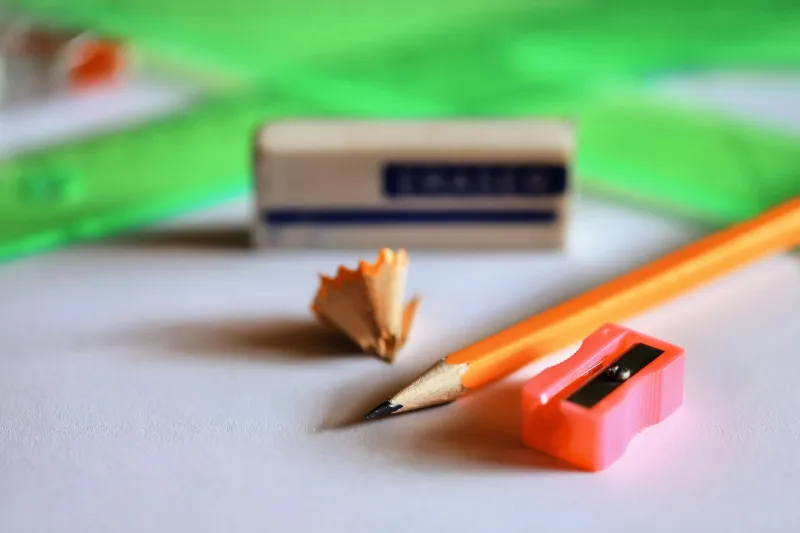
Pick up any pencil in America and there it is — that small, stubby eraser on the end, so ordinary you probably haven't thought about it since second grade. But for most of human history, making a mark meant living with it. Scratching out a pencil line meant reaching for a crust of bread, a pumice stone, or just accepting the smudge as permanent evidence of your imperfection. The rubber eraser didn't just give people a way to fix mistakes. It quietly rewired how entire generations thought about error, education, and second chances.
And it almost never happened at all.
A Confused Chemist and a Strange Piece of Rubber
The story starts in London in 1770, in the kind of cluttered, experiment-filled workspace that produced most of the era's great discoveries. An English engineer and scientist named Edward Nairne was reportedly searching for a piece of pumice — a porous volcanic rock commonly used at the time to rub out pencil marks on paper. Instead, he grabbed a small chunk of natural rubber, likely imported from South America, where indigenous peoples had long been using the sap of the Hevea brasiliensis tree for waterproofing and molding.
Nairne rubbed the rubber across his paper, probably expecting nothing. What he got instead was a clean erasure — far cleaner, in fact, than pumice ever managed. The rubber lifted the graphite from the page without tearing the paper's fibers or leaving the dusty residue that pumice produced.
He started selling the little chunks of rubber for three shillings apiece — an enormous sum at the time, roughly equivalent to a day's wages for a skilled laborer. Still, people bought them. The product worked, and working was enough.
The same year, the prominent scientist Joseph Priestley documented the substance's erasing properties in print, noting that it was "excellently adapted to the purpose of wiping from paper the marks of a black-lead pencil." Priestley is also credited with coining the term "rubber" — simply because the material rubbed things away. The name stuck so thoroughly that in Britain, the word rubber still means eraser today, a fact that causes endless confusion for American tourists.
From Novelty to Necessity — Slowly
For all its obvious usefulness, the rubber eraser didn't immediately conquer the world. Early natural rubber had serious limitations. It rotted in heat, cracked in cold, and smelled genuinely terrible. The chunks Nairne sold were essentially raw latex, and they degraded quickly. For decades, the eraser remained a luxury curiosity — something wealthy professionals might keep in a desk drawer, not a standard-issue tool for everyday life.
The transformation came in 1839 when Charles Goodyear — yes, that Goodyear — accidentally discovered vulcanization, a heat-and-sulfur process that stabilized rubber and made it durable across a wide range of temperatures. Suddenly, rubber could be manufactured reliably, cheaply, and in enormous quantities. Within a generation, the eraser went from chemist's novelty to mass-produced commodity.
The attached-eraser pencil — the design that's now considered totally standard in the United States — was patented in 1858 by a Philadelphia artist named Hymen Lipman, who had the straightforward idea of gluing a small piece of rubber to the top of a pencil. It sounds almost embarrassingly simple in retrospect. At the time, it was considered clever enough to patent. Lipman sold that patent for $100,000, a staggering fortune in the post-Civil War economy.
The Teachers Who Hated It
Here's where the story gets genuinely surprising: when erasers started becoming common in American schools during the mid-to-late 1800s, a significant number of educators pushed back. Hard.
For many teachers of that era, permanence was the point. A mistake left visible on the page was a lesson learned — a tangible record of the cost of carelessness. Allowing students to simply rub away errors, the thinking went, undermined discipline and promoted intellectual laziness. Some schools outright banned erasers from classrooms, insisting that students who made marks should stand behind them.
The philosophical argument wasn't entirely without merit. There's a legitimate pedagogical case for learning to live with imperfection, to slow down and think before committing to paper. But the resistance also reflected something darker — a Victorian-era belief that failure should leave a mark, literally and figuratively, and that the ability to correct oneself too easily was a kind of moral weakness.
That resistance faded as the 20th century progressed, replaced by more progressive educational theories that framed mistakes as a natural part of learning rather than evidence of character flaws. The eraser, in a roundabout way, became a physical symbol of that philosophical shift.
The Eraser's Quiet Legacy
Today, the United States alone produces billions of pencils annually, and the vast majority come with erasers attached — a design so standard it's essentially invisible. The pink color that most Americans associate with erasers? That came from a pumice-infused rubber compound developed in the early 20th century, which happened to produce a distinctive rosy hue. It was functional, not decorative, but the color became so synonymous with erasers that generations of American children grew up assuming pink was simply what erasers looked like.
Digital tools have arguably made the physical eraser redundant — the undo button is the eraser's spiritual successor, and it works a lot faster. But the rubber eraser's deeper legacy isn't really about graphite on paper. It's about a shift in how Western culture came to view mistakes: not as permanent stains, but as correctable steps on the way to something better.
All of that, from a chemist who grabbed the wrong thing off his workbench.