The 16-Foot Rule: How the Pentagon's Trucking Worries Built Every Overpass You've Ever Driven Under
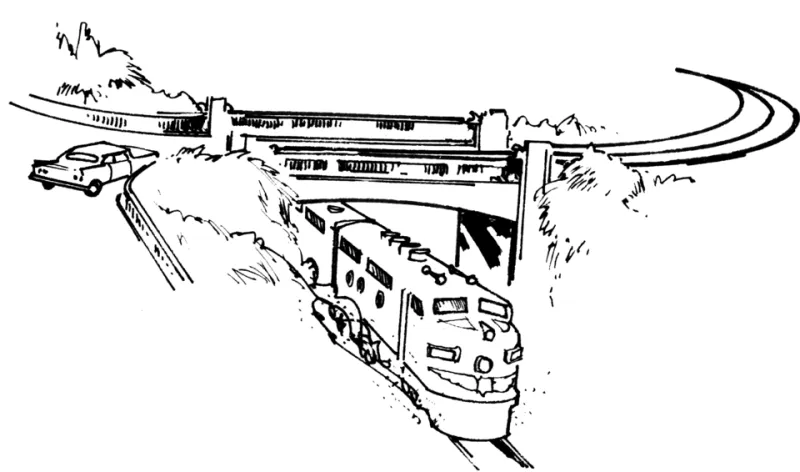
Photo: Pearson Scott Foresman, Public domain, via Wikimedia Commons
Drive almost any interstate in America and you'll pass under dozens of overpasses without giving them a second thought. But here's a strange detail hiding in plain sight: most of them hover around the same height, give or take a few inches. Fourteen feet. Sixteen feet. Never wildly different. Highways are supposedly engineered by committees and cost-cutters and local politics — so why do the bridges all seem to agree with each other?
The answer involves the Cold War, a fleet of imaginary military trucks, and one of the most consequential measurements nobody thinks about.
A Highway System Built With an Invasion in Mind
When President Eisenhower signed the Federal-Aid Highway Act of 1956, the project wasn't pitched as a convenience for summer vacations. The official framing leaned heavily on national defense. The system's formal name even included the word "Defense." Military planners had spent years worrying about one scenario in particular: if Soviet tanks rolled into Western Europe, how fast could American troops and equipment move?
In 1956, the same year the highway bill passed, civil engineers and defense officials published specifications for what military vehicles would need from the new roads. The critical number was vertical clearance. Standard military transport trucks, carrying their gear, needed at least 14 feet of room — and the engineers recommending the standard built in a cushion, settling on 16 feet as a minimum for overpasses and sign structures.
That single recommendation became a guideline, and the guideline became muscle memory for every state department of transportation that followed.
Concrete Has a Long Memory
Here's the thing about infrastructure: decisions don't get revisited unless something forces them to. Once states began pouring overpasses in the late 1950s and '60s, the 16-foot standard (with 14 feet as an absolute floor on older or constrained routes) was simply how the work got done. Contractors built to spec. Spec came from the federal guidelines. Nobody had a reason to deviate.
And so a Cold War trucking requirement fossilized itself into the American landscape. That gas station canopy on the edge of town, that railroad bridge outside Harrisburg, that low-slung concrete arch on your commute — all of them are quietly obeying a rule written for vehicles that mostly never existed outside of planning documents.
The Truck That Broke the Rule
Of course, the system occasionally meets its match. Ask any trucker about the "Canam" — the infamous overpass in Durham, North Carolina, that became a viral sensation for shearing the roofs off rental trucks year after year. Its clearance: 11 feet 8 inches, a relic of a 1920s railroad bridge that predates the interstate standards entirely.
The gap between old infrastructure and new standards is exactly why GPS apps for commercial drivers exist. When something doesn't conform to the 16-foot logic of the interstate era, the modern highway network treats it like a glitch — because, in a sense, it is.
Why It Still Matters
The 16-foot rule is a reminder that the ordinary world is layered with decisions made decades ago, for reasons that have often evaporated. The Soviet threat is gone. The military convoys never rolled. But every overpass from Bangor to San Diego still carries their dimensions.
So the next time you're on a cross-country drive and the bridges start blurring together, take it as a small act of archaeology. You're not just looking at concrete. You're looking at 1956 — still standing, still holding its line, sixteen feet above the asphalt.