How a Bird Nobody Liked Ended Up at the Center of America's Biggest Dinner
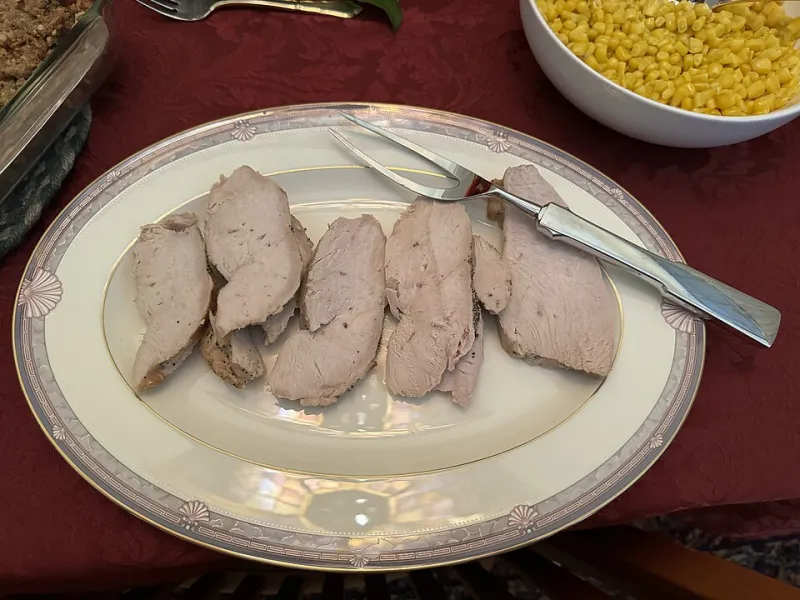
Photo: Missvain, CC BY 4.0, via Wikimedia Commons
Every November, Americans buy roughly 46 million turkeys. They brine them, deep-fry them, smoke them, and argue loudly about whether dry-rubbing is superior to wet-brining. The turkey has become so inseparable from Thanksgiving that the holiday has an entire alternate nickname — Turkey Day — and the bird's image appears on decorations, greeting cards, and children's hand-tracing projects from coast to coast.
None of this was inevitable. For a significant stretch of American history, the turkey was the bird you ate when you had no better options. It was tough, time-consuming to prepare, and considered by many early American cooks to be more trouble than it was worth. The fact that it now anchors the country's most food-obsessed holiday is the result of a long, strange chain of events involving colonial desperation, railroad economics, and one remarkably influential magazine editor.
What the Colonists Actually Ate
The mythology of the first Thanksgiving — the 1621 harvest celebration at Plymouth Colony — is deeply entangled with the turkey, but the historical record is considerably less tidy. Only two primary sources describe the actual event, and neither mentions turkey specifically. Edward Winslow's account references "fowl" that the colonists hunted, which could have included ducks, geese, or any number of other birds. Deer is explicitly mentioned. The turkey's starring role in the origin story was largely a retrospective invention.
In the colonial period, wild turkeys were certainly present in North America — they were native to the continent and abundant in ways that European settlers found remarkable. But abundance doesn't equal preference. Contemporary accounts from early American settlers describe wild turkey as lean, gamey, and requiring considerable effort to make palatable. Domestic animals like pigs and cattle, when available, were generally preferred. Geese were a more common celebratory bird, being fattier, more flavorful, and already established as a European feast tradition.
The turkey had a practical advantage, though, that would eventually matter enormously: it was cheap to raise, required little grain, could forage for itself, and could be walked to market on its own feet — a genuine logistical consideration in an era before refrigeration, when transporting slaughtered meat over long distances was a serious problem.
The Near-Extinction Nobody Talks About
By the early 19th century, the wild turkey had been hunted so aggressively across the eastern United States that populations had collapsed dramatically. Unregulated market hunting, combined with deforestation clearing the birds' natural habitat, pushed wild turkeys to the edge of extinction in many states. By the mid-1800s, they had been completely eliminated from large portions of New England — the exact region most associated with Thanksgiving tradition.
This near-disappearance is one of the more ironic footnotes in the turkey's story. The bird that would become the symbol of American autumn abundance had nearly been eaten into oblivion by the time that symbolism was being constructed. Wild turkey populations didn't begin recovering until the 20th century, thanks to conservation programs and reintroduction efforts — meaning the turkey on most Americans' Thanksgiving tables was, for most of American history, a domestic breed that bore only passing resemblance to the wild bird the colonists had encountered.
The Woman Who Wrote Thanksgiving Into Existence
The single most important figure in establishing turkey as the Thanksgiving centerpiece was not a farmer, a politician, or a chef. She was a magazine editor from New Hampshire named Sarah Josepha Hale.
Hale is best remembered today for writing "Mary Had a Little Lamb," but her more consequential legacy was a 36-year campaign to establish Thanksgiving as a national holiday. From her position as editor of Godey's Lady's Book — the most widely read magazine in America during the mid-19th century, with a readership estimated at 150,000 households at its peak — Hale wrote annual editorials urging presidents to declare a unified national day of thanksgiving.
She also, crucially, published detailed descriptions of the ideal Thanksgiving meal. Her 1827 novel Northwood contained what many food historians consider the first detailed literary description of a Thanksgiving dinner, and it featured roast turkey prominently. Her magazine followed with recipes, menus, and illustrations that planted turkey at the center of the holiday's imagined table for millions of American readers.
When Abraham Lincoln finally declared Thanksgiving a national holiday in 1863 — in part responding to Hale's persistent lobbying — he was essentially ratifying a tradition that her publishing platform had spent decades constructing. The turkey wasn't chosen through any democratic process or culinary consensus. It was editorially selected by one very determined woman with a very large magazine.
How the Railroad Finished the Job
Hale's influence established the cultural expectation. The railroad made it logistically possible.
Before the expansion of the national rail network in the latter half of the 19th century, sourcing a large bird for a late-November dinner was a genuinely regional proposition. What you ate depended heavily on what was available where you lived. In the South, pork remained the dominant festive protein well into the 20th century. In coastal New England, seafood competed seriously with any land bird.
As railroads connected the country and created national food distribution networks, the turkey industry — centered primarily in the Midwest — could ship birds to markets across the country at scale. Refrigerated rail cars, introduced in the 1870s and expanded rapidly over the following decades, solved the preservation problem that had long made long-distance meat shipping impractical.
For the first time, a family in Georgia or Oregon could reliably purchase a turkey in late November. The national holiday now had a national food supply to match its national aspiration. Grocery chains, emerging as a retail force in the early 20th century, standardized the connection further — stocking turkeys aggressively in the weeks before Thanksgiving and marketing them as the holiday purchase.
The Bird That Became a Symbol
By the mid-20th century, the feedback loop was self-reinforcing. Turkeys were what Americans ate on Thanksgiving because Americans had always eaten turkey on Thanksgiving — even though "always" meant roughly three or four generations at most, and even though the tradition had been constructed through a combination of editorial influence, railroad logistics, and grocery store marketing rather than any deep historical continuity.
The turkey's actual qualities — its challenging texture, its tendency toward dryness, the sheer logistical effort required to cook a 20-pound bird properly — became features rather than bugs. The difficulty was part of the ritual. The annual debate over brining technique, the competitive family recipes, the leftover turkey sandwiches elevated to near-mythological status — all of it built on a foundation that was, at its core, a second-choice bird that a magazine editor decided deserved better.
Benjamin Franklin famously suggested the turkey as the national bird over the bald eagle, calling it a "much more respectable bird" and a "true original native of America." He was outvoted. But in one sense, the turkey won anyway — not on the national seal, but on the national table, every fourth Thursday of November, without exception.
Not bad for a bird that, for most of its American history, was considered barely worth the effort.