Percy Spencer Melted a Candy Bar and Accidentally Rewired the American Kitchen
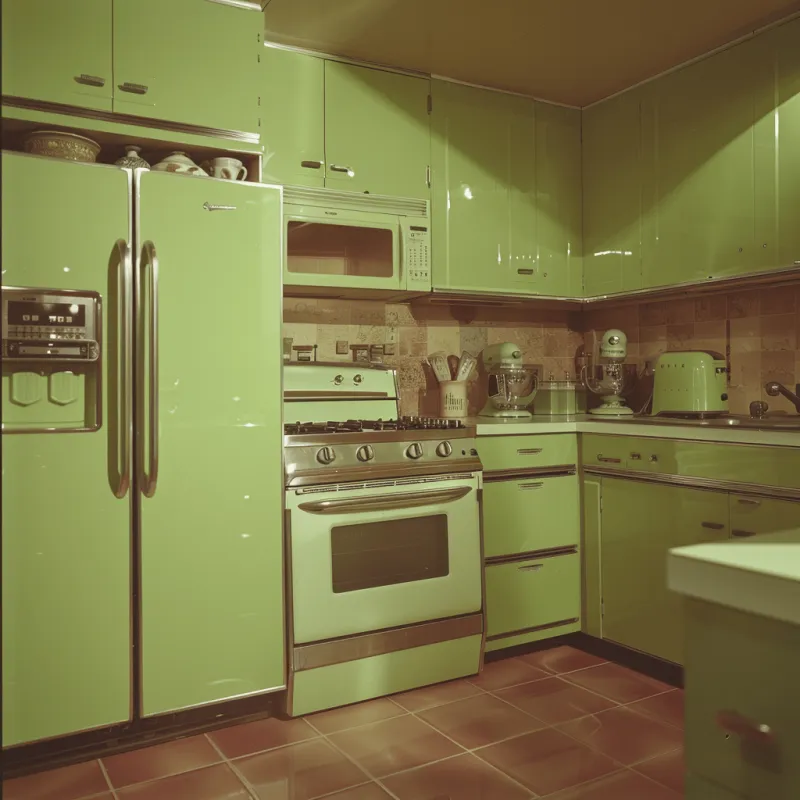
Photo: vintage 1970s kitchen microwave oven countertop retro appliance, via edwardgeorgelondon.com
There is a kitchen appliance in your home that cooks food using the same basic technology that guided Allied aircraft during World War II. You probably used it this morning. You almost certainly didn't think about that.
The microwave oven has one of the stranger origin stories in American consumer history — a tale that involves military radar, a self-taught engineer, a ruined chocolate bar, and thirty years of public suspicion that the thing might be quietly killing everyone who used it.
The Engineer Who Taught Himself Everything
Percy Spencer grew up in rural Maine in the early 1900s under genuinely difficult circumstances. His father died when he was a toddler, his mother left him with relatives, and he dropped out of school at twelve to help support his family by working at a nearby spool mill. He never received a formal technical education.
What he did receive was an insatiable appetite for understanding how things worked. He read constantly, taught himself mathematics and physics, and by his late teens had learned enough about electrical engineering through self-study to get a job in radio technology. During World War I he developed an interest in wireless communications, and by the time World War II arrived, Percy Spencer was one of Raytheon's most valuable engineers — a man with no college degree who held 300 patents and had personally figured out how to mass-produce magnetrons (the radar-powering vacuum tubes that the Allied forces desperately needed) at a rate far beyond what anyone thought possible.
He was, by any measure, exactly the kind of person who would notice something unusual and immediately want to understand why.
The Candy Bar in the Shirt Pocket
The discovery happened in 1945. Spencer was standing in front of an active magnetron — a device that emits microwave radiation as part of its radar function — when he noticed that a peanut cluster candy bar in his shirt pocket had melted. This wasn't entirely shocking on its own; the area around active radar equipment got warm. But Spencer was curious enough about the specific nature of the melting to start experimenting deliberately.
He pointed microwave radiation at popcorn kernels. They popped. He tried an egg. It exploded (reportedly in the face of a colleague, which is the kind of detail that gets left out of the sanitized versions of this story). The pattern was clear: microwave radiation was generating heat inside food, cooking it from the inside out at a speed that conventional ovens couldn't approach.
Raytheon filed a patent for a microwave cooking device in 1945. The first commercial unit, called the Radarange, was introduced in 1947. It stood five and a half feet tall, weighed 750 pounds, required a water cooling system, and cost around $5,000 — roughly $65,000 in today's dollars. It was marketed primarily to restaurants, railroad dining cars, and institutional kitchens. Nobody was putting one of these in their home.
The Name Problem and the Fear Problem
For the better part of two decades, the microwave oven sat in a strange limbo. The technology worked. The cooking results were impressive. But two enormous obstacles kept it out of American homes.
The first was practical: the machines were simply too large and too expensive for domestic use. Engineers spent years working on miniaturization, and by the mid-1960s, countertop models had begun to appear. Raytheon acquired Amana Refrigeration in 1965 and launched the Amana Radarange for home use in 1967 at around $500 — still expensive, but within reach of middle-class households.
The second obstacle was harder to engineer away: Americans were afraid of the thing.
The word "radiation" was doing a lot of psychological damage in postwar America. The atomic bombings of Hiroshima and Nagasaki had made radiation synonymous with catastrophic harm, and the Cold War kept those fears fresh and immediate. When manufacturers tried to explain that microwave radiation was non-ionizing — fundamentally different from the nuclear radiation people feared — the explanation didn't land cleanly. Invisible waves cooking your food from the inside sounded, to a lot of people, like exactly the kind of thing that would turn out to be quietly terrible.
Sales were slow. Consumer surveys from the late 1960s and early 1970s consistently showed that a significant portion of American households either didn't trust microwave ovens or actively didn't want one. Rumors circulated about radiation leakage. Some people worried about the long-term effects of eating "irradiated" food, confusing the microwave process with actual radioactive contamination.
The Moment America Gave In
The cultural shift came in stages rather than all at once, and it was driven largely by the changing structure of American family life.
The 1970s brought more dual-income households, longer working hours, and a growing demand for convenience in the kitchen. Frozen food manufacturers had been building their industry for decades, and by the mid-70s the American freezer was full of products just waiting for a faster way to be heated. The microwave slotted into this landscape perfectly. It wasn't replacing home cooking so much as it was enabling the version of home cooking that time-pressed American families were actually practicing.
Manufacturers also got smarter about language. The word "Radarange" quietly disappeared. Marketing leaned into speed and convenience rather than technology. Cookbooks specifically written for microwave cooking appeared on shelves, domesticating the appliance and making it feel like a natural kitchen tool rather than a piece of military hardware that had wandered into your home.
By 1975, microwave oven sales in the US had surpassed those of gas ranges for the first time. By the mid-1980s, more than half of American households owned one. By the end of the decade, it was closer to 80 percent.
Percy Spencer, who died in 1970, didn't live to see the microwave become the countertop fixture it is today. He didn't plan any of it — not the discovery, not the decades of skepticism, not the eventual cultural surrender. He just noticed a melted candy bar and asked why.
That's usually how it starts.