Nobody Designed the Dollar Sign — It Just Happened
There are symbols that were deliberately created — the peace sign, the recycling logo, the Wi-Fi icon — with a known designer, a specific commission, a recorded moment of origin. And then there's the dollar sign. The $ is one of the most universally understood characters in existence, printed billions of times a day across receipts, spreadsheets, news tickers, and text messages. And nobody actually designed it. It just sort of... accumulated into existence, passed between merchants and printers and letter writers until it became too established for anyone to replace.
The honest answer to where it came from is: we're not entirely sure. But the journey through the competing theories is its own kind of story.
The Spanish Colonial Theory (The Leading Contender)
The most widely accepted explanation traces the $ back to the Spanish peso, specifically to a shorthand abbreviation used in colonial trade documents throughout the Americas during the 1700s. Spain's currency at the time was officially called the peso de ocho — or in English, the piece of eight — and it dominated commerce across both North and South America long before the United States existed as a country.
 Photo: United States, via worksheets.clipart-library.com
Merchants and clerks handling large volumes of transactions needed a faster way to write peso amounts in ledgers. The abbreviation they landed on was "PS" — standing for "pesos" — which they would sometimes write in a rush with the S slightly overlapping the P. Over time, the loop of the P faded into a vertical stroke, and what remained looked remarkably like an S with one or two lines through it.
This theory has genuine documentary support. Handwritten commercial correspondence from the late 1700s shows exactly this kind of abbreviation in use across the Americas, and the timing aligns almost perfectly with the emergence of the symbol in early American business writing. When the United States created its own currency in 1792, the dollar was deliberately pegged in value to the Spanish peso — so borrowing a visual shorthand that merchants already associated with that denomination made practical sense.
The Monogram Nobody Can Fully Trace
A competing theory points to the letters U and S — as in United States — written in an overlapping monogram style, with the U eventually losing its bottom curve and leaving something that looked like an S with two vertical lines. It's a tidy explanation, and it has the advantage of being patriotically satisfying. The symbol for the dollar literally contains the country's initials.
The problem is that the documentary evidence doesn't fully cooperate. The $ appears in American writing around the same time that the Spanish peso abbreviation theory would predict, but the U-over-S monogram explanation struggles to produce the actual handwritten transition that would prove the case. Most serious monetary historians find the Spanish peso origin more convincing, though the U.S. monogram story has proven remarkably persistent in popular retellings precisely because it's so clean.
The Printer Who Spread It Without Meaning To
Whatever its precise origin, the dollar sign's real explosion into widespread use came through the printing press — and through a very specific kind of practical laziness.
In the early decades of American independence, printers setting type for newspapers, commercial documents, and correspondence didn't have a dedicated $ character available in most typefaces. When they needed to indicate dollar amounts, they improvised. Some used a capital S with a slash through it. Some used the abbreviation "dol." Some used a figure that looked like a stylized combination of letters. The inconsistency was widespread and entirely unglamorous.
As American commerce expanded through the early 1800s and printing became more standardized, typeface manufacturers began casting dedicated $ characters to meet demand. But because there was no official standard — no government body had ever formally specified what the symbol should look like — different foundries produced slightly different versions. Some had one vertical line through the S. Some had two. Both variants circulated simultaneously for decades, and both are still technically acceptable today.
The symbol that emerged from this chaotic process wasn't the result of a design committee or a government decree. It was the residue of thousands of individual shortcuts made by merchants, clerks, and typesetters who needed a faster way to write a number.
Why It Spread Faster Than Anyone Questioned It
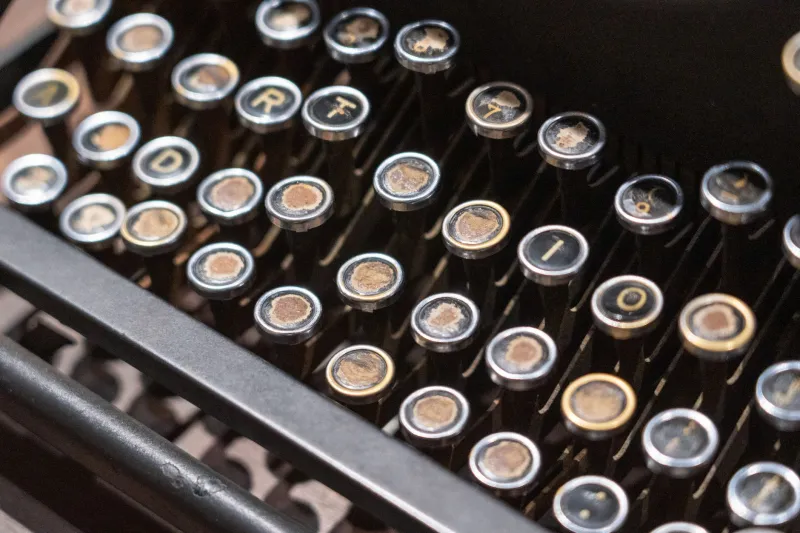
By the mid-1800s, the $ was effectively universal in American commercial life. It appeared in newspapers, contracts, correspondence, and eventually on the first typewriters — which cemented it permanently into the mechanical and later digital keyboard layout that still governs how we type today.
The symbol's spread was self-reinforcing in the way that all successful shorthand tends to be: once enough people are using the same mark to mean the same thing, questioning it becomes more trouble than it's worth. No one convened a meeting to officially adopt the dollar sign. No president signed it into law. It simply reached a threshold of common use beyond which it became, for all practical purposes, official.
What makes the story genuinely strange is that one of the most powerful symbols in global commerce — a character associated with capitalism, wealth, ambition, and American economic identity — has no clean inventor, no founding moment, and no authoritative design specification. It evolved the way language evolves: messily, collectively, and without anyone in charge.
The next time you type it, you're repeating a gesture that Spanish colonial merchants made in a hurry, that American printers improvised around, and that nobody ever formally approved. It just stuck. And now it's everywhere.